Project
AIDN Product Design
Role
Senior UX/UI Product Designer
Period
2024
Artificial Intelligence Defined Networking. Creating Networking tools leveraging AI.
Learnings
Shared across organization
AI/ML
Implementation expertise
Cross-functional
Processes established
Gallery
01
First of its kind
Security and Monitoring
I worked closely with Network Security Engineers to discover their pain points when using their tools day-to-day. We crafted a feature called "Security Events" that would leverage additional AI to intelligently automate aggregating alerts and network data, saving a significant amount of time and effort.
I wanted to provide an alternate way of viewing network issues, in addition to the large tables and toast notifications common for these tools, so the Development team and I brought in a node graph that served as a "conversation map" of connected AI agents throughout the network.
Defender: Network IDS
AIDN IDS Monitoring screen in light and dark mode, showing how users interact with AI-powered security detection and response.
02
It's not about me
User-Centered AI Design
How do I empower the user while simultaneously reducing their need to take action?
What's important to realize is that I am not designing a traditional software tool. I am establishing ways for users to interact with intelligence that will act on their behalf.
User Archetypes
The first step for me was to align the technology with the target users we were creating this product for. Creating user archetypes allowed me to narrow down who we were actually trying to serve and what features we should consider building into the product.
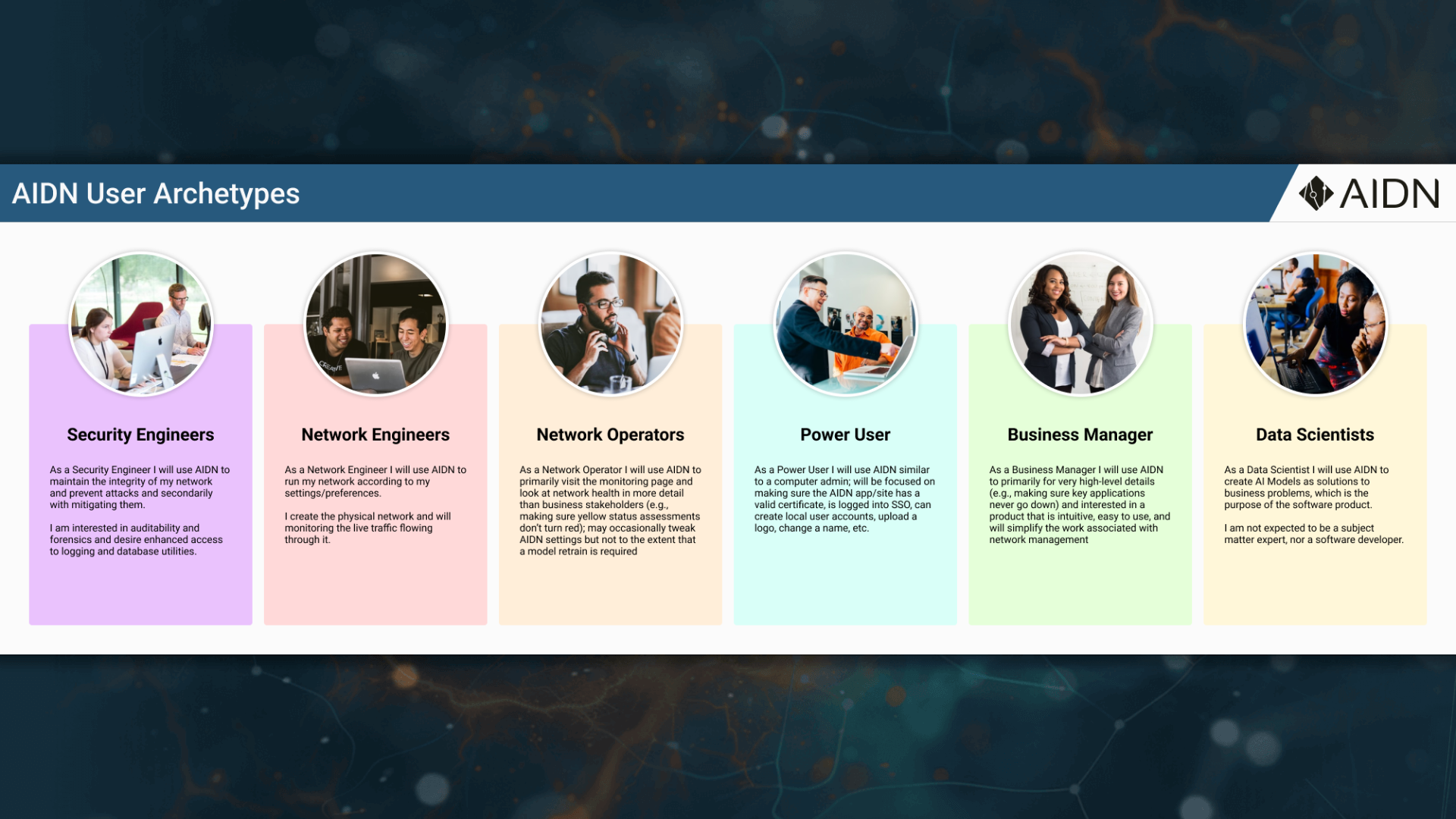
This actually caused us to shift away from many of the features of the prototype since those things were supporting data scientists, who are not actual users found within our customer organizations. However, learning more about the data scientists allowed me to learn about how they are looking at the problems of our users and how they approach solutions, giving me great insights into AI and machine learning.
User Personas
Once I had established the user archetypes for the product, I proceeded to build user personas. Each persona is a compilation of various people who represent a specific archetype. I really enjoy these interviews because I get a glimpse of the person behind the profession and gain a bit more understanding of why they do what they do.
My First Pass
- In the beginning, my first goal was to establish a stable foundation for the front-end of the product. I worked with developers to choose which front-end framework we would use and what platforms we would support.
- Afterwards, I created an AIDN Design System that would allow me to freely update styles and provide assets easily.
- I then focused on updating the look and feel of the original prototype, applying UX principles, and creating additional features common to modern software tools.
03
Understanding this world
Learning AI, ML, and Networking
What, exactly, is AI?
When I first joined AIDN, AI was just beginning to get noticed. Fortunately, I was able to work closely with our team of Data Scientists and gain real insights into the technology. Through this project, I learned about Generative AI models, Large Language Models (LLMs), Data Engineering and pipelines, and various machine learning techniques.
I focused my efforts on figuring out how to bring this technology to users without them needing to be Data professionals themselves, and not feel alienated from their work.
Networks are like Onions
I aim for a deep understanding of my target audience and their environment, so that I can articulate their problems accurately and provide solutions for those problems. I made graphic explorations to understand the fundamentals of networking based on learning sessions provided by subject matter experts.
Layers of Security
I created info-graphics to gain a better understanding of the security related issues of each network layer. I am very grateful to my team members and subject matter experts, who shared their knowledge with me and helped me create these artifacts.
04
Look and Feel
Visual Design and User Experience
Using your IDS AI
The core functionality of AIDN Security is the Intrusion Detection System AI. A security engineer can view AI agents that are watching their network and providing attack and anomaly alerts.
I wanted to reduce information overload for our users, so I crafted a hierarchical flow, revealing additional detailed information as needed by the user.
Managing your IDS AI
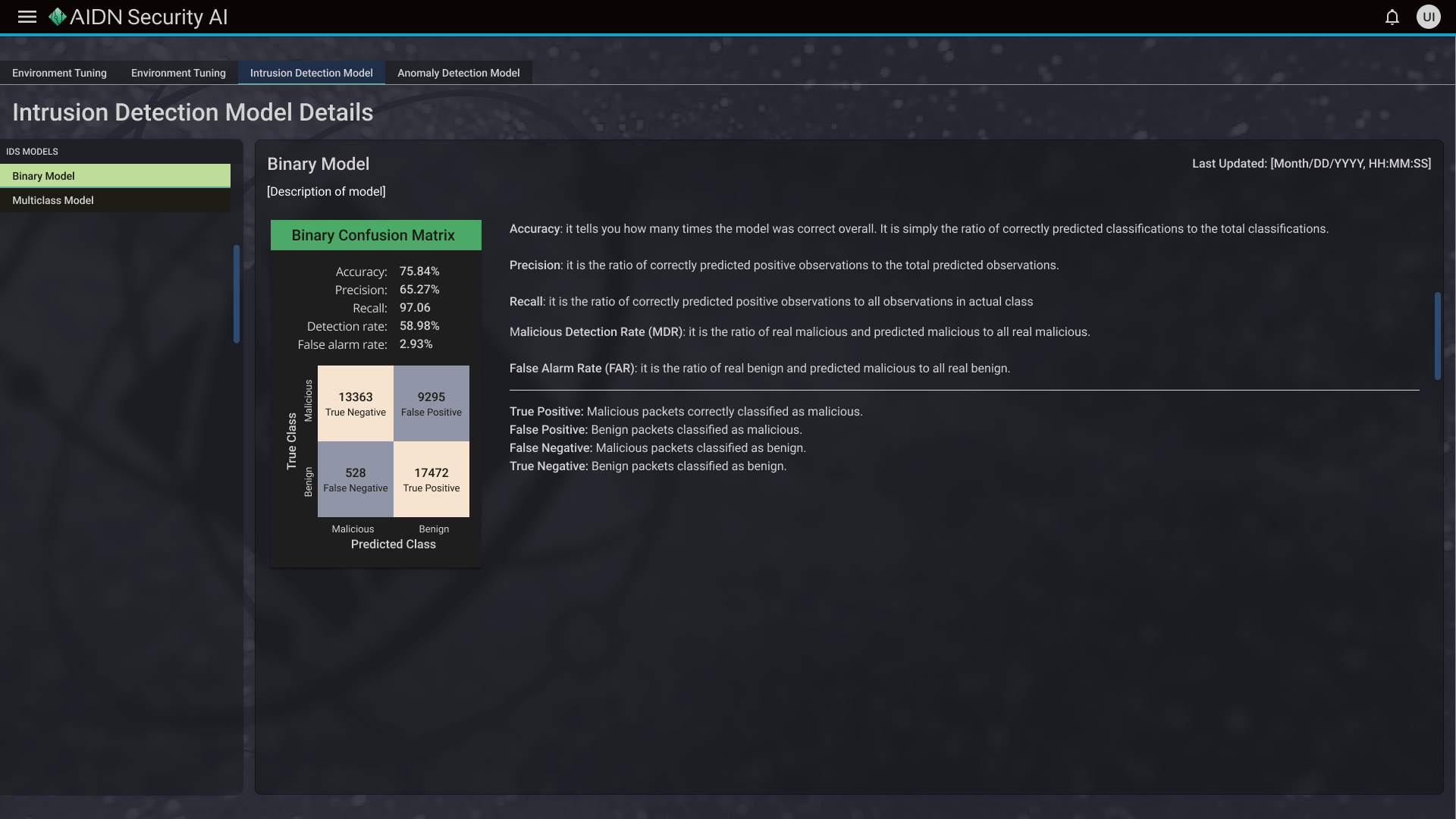
Transparency and trust. What exactly is this AI doing to my system? How do I know it is working? We provide these answers and ways to interact with AI models through multiple focused tabs.
I recommended we add a glossary of commonly used AI model terms to help educate and inform users in the moment.
User Journeys
The unique challenge of this entire project was designing the user experience of interacting with an AI that would do much of the work and still accomplish the goals of the user that they expect from the product.
I worked very closely with security experts and learned about their day-to-day operations and obtained vital minimum requirements they need to investigate security issues that our AI detected.
UX Foundations
My goal is to communicate clearly. This is my typical approach to solving any problem, usually in collaboration with subject matter experts, developers, and other designers.
- Step 1. Discover the user's problem.
- Step 2. Capture solution flow.
- Step 3. Map out potential user journeys.
- Step 4. Sketch a lo-fidelity wireframe of the UI.